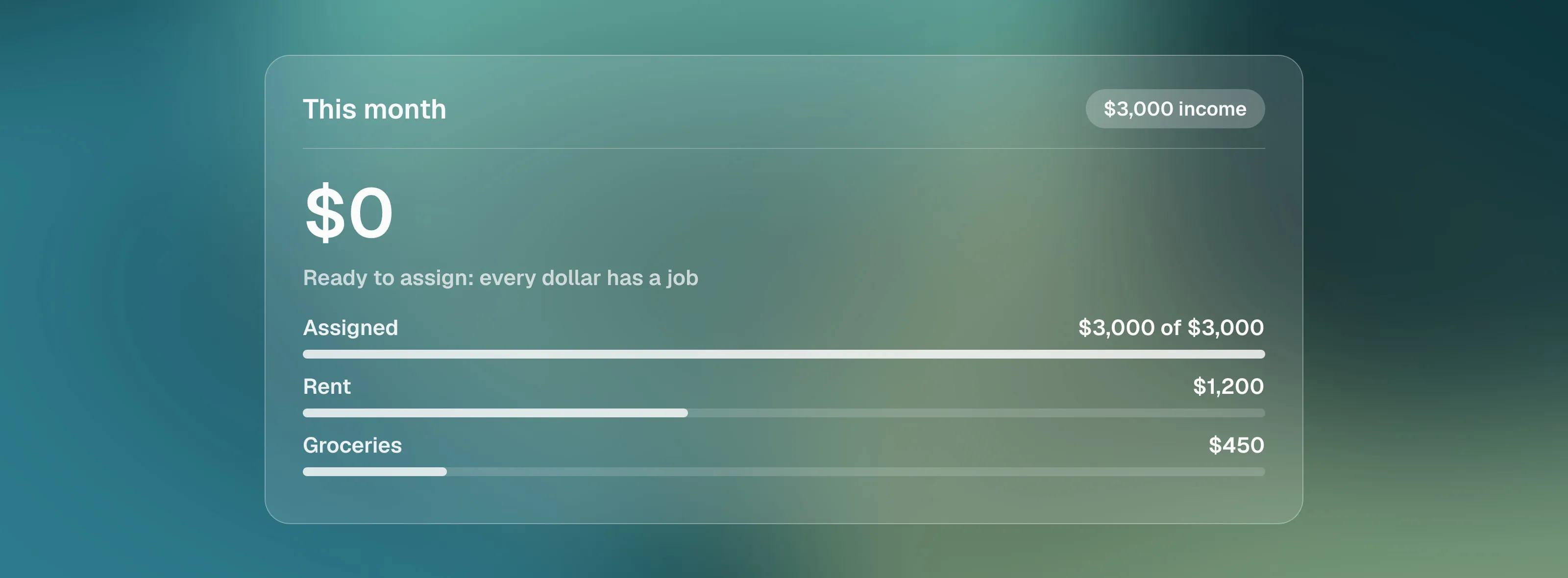
Zero-based budgeting sounds more complicated than it is. At its core it is a simple way to understand where your money goes, and to make choices that fit your life. The idea is the same for a first budget as for a tenth: you decide what each amount of money is meant for.
What zero-based budgeting really means
Instead of letting your income spread across the month on its own, you make intentional decisions about where it goes, based on what matters right now.
A simple definition
Your monthly income is fully planned out before the month begins. Not in a rigid way, but in a structured one that helps you see the full picture. The goal is not a perfect plan — it is understanding how you want to use your money this month.
You decide what each amount of money is meant for
You look at the income you have and decide what each amount is for: bills, savings, groceries, responsibilities, or goals you are working toward. Nothing is left floating without meaning.
You start from zero each month, but not from zero in life
Zero does not mean you erase everything or pretend you are starting from scratch. It means you look at each month with fresh eyes instead of copying last month’s plan. Life changes, and your budget can change with it.
A short history
The idea has been around for decades. It first appeared in the 1970s, when Peter Pyhrr, a manager at Texas Instruments, was looking for a clearer way for organisations to plan their budgets. His approach asked teams to look at each new period with fresh eyes instead of repeating past assumptions.
From corporate planning to everyday budgets
The method was originally used in business and public-sector planning, but it turned out to work just as well for personal finance. The structure was simple, flexible, and easy to adapt. The core idea stayed relevant: plan your income with intention, not on autopilot.
How it works in daily life
Start with your real income
Begin with what you actually expect to receive this month: a salary, freelance work, a bonus, anything else. It does not have to be exact to the dollar — an estimate is enough. The point is to know what you are working with.
List what matters this month
Before dividing anything, note the things that matter right now: bills, food, transport, savings goals, family needs, upcoming plans. You are not accounting for a whole year, only for the month in front of you.
Decide what each amount is meant for
Assign each part of your income to a category or purpose. Some amounts go to essentials, some to goals, some to things that make life lighter. When everything is assigned, nothing is left without meaning.
Adjust when life happens
Budgets do not always go as planned, and the method expects that. If something unexpected comes up, you shift money between categories and keep going.
A simple example
Meet Alex — someone with a typical monthly income and everyday priorities, not a perfect planner or a financial expert. Alex brings in $3,000 this month. The priorities are straightforward: rent, groceries, transport, a small savings goal, and room for things that make life feel good.
From $3,000 income to $0 unassigned
| Category | Amount |
|---|---|
| Rent | $1,200 |
| Groceries | $450 |
| Savings (emergency fund) | $300 |
| Utilities | $200 |
| Personal spending | $200 |
| Upcoming trip | $200 |
| Transport | $150 |
| Health and wellness | $120 |
| Subscriptions | $100 |
| Phone and internet | $80 |
| Left unassigned | $0 |
Every dollar has a job. Nothing strict, nothing overcontrolled — just a clear picture.
Adjusting mid-month without guilt
Halfway through the month, a friend invites Alex on a weekend trip. It is not in the plan, but it feels worth doing. Instead of treating it as a failed budget, Alex moves $50 from personal spending and $30 from groceries, where there was a little extra, and puts $80 into weekend plans.
It takes less than a minute, and the plan still works.
Why it helps
More clarity, less anxiety
Uncertainty creates stress. When you are not sure where your money is going, even small decisions feel heavier than they should. Zero-based budgeting lets you see what is planned, what is available, and what needs attention, without guessing.
Your priorities stay visible
When you assign each part of your income, your real priorities rise to the surface — a goal you have been putting off, a responsibility you want to stay on top of, something that brings joy. You start making choices that fit your life rather than someone else’s rules.
It works with imperfect months too
If a bill is higher, plans shift, or something unexpected happens, you adjust. No guilt, no starting over, no pressure to get everything right.
Common misunderstandings
“It is too strict for me”
Planning your full income can sound like a big commitment. In practice the method is flexible: it gives you a starting point, and you can move money whenever things change. It is a structure, not a set of rules.
“My income is irregular, so this will not work”
Irregular income does not prevent you from using this method — it means you plan differently. You begin with what you realistically expect this month and update the plan as the amount changes. There is a fuller guide to that.
“I do not want to track every cent”
Zero-based budgeting is not about micromanaging every dollar. It is about deciding what your money is meant for. You can track in broad categories or in more detail — the goal is awareness, not accuracy for its own sake.
How Lighthouse uses zero-based principles
A clear view of what you have and where it goes
Lighthouse keeps your income, plans, upcoming bills and goals in one place, so you get the whole picture at a glance instead of digging through spreadsheets or scattered notes.
Change the plan whenever the month changes
You can adjust your plan at any time: move money between categories, update priorities, or change the month’s focus. The budget adapts to your life rather than the other way around.
A calm place to make money decisions
Clear categories and a simple view help you stay aligned with your priorities. It is somewhere to pause, review, and decide what comes next, even on the days when life feels busy.
Sketch your first plan
You do not need a special moment, a flawless plan, or a completely organised month. You can sketch your first plan on paper or in a note, or create it in Lighthouse when you are ready. If the whole idea still feels early, start with what to expect in the first months instead.