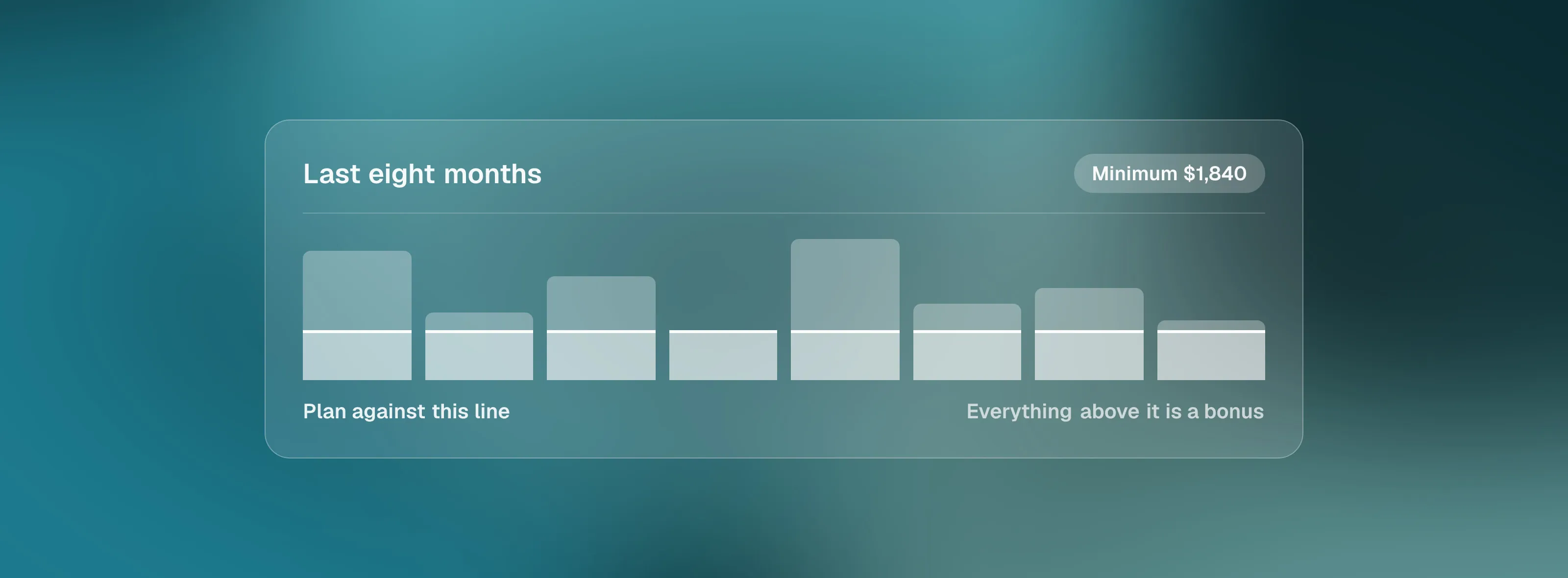
Irregular income makes budgeting feel impossible. When your pay changes month to month, it is hard to know what you can afford. But budgeting with inconsistent income works — it just starts from a different number, and it does not need strict rules or accurate predictions.
This is a realistic way to plan when your month never looks the same twice, whether you freelance, work part time, or have income that simply varies.
Why irregular income feels overwhelming
Uncertainty creates pressure
When you do not know how much you will earn, even simple decisions feel stressful. That pressure often turns into avoidance — not because you do not care, but because the unknown is heavy.
Traditional budgeting advice does not fit
Most classic budgeting advice assumes a stable paycheque. When income fluctuates those systems stop making sense, and that is a problem with the advice rather than with you.
You do not need exact numbers to create stability
A calm budget with irregular income works on ranges and intentions, not forecasts.
The method, in five steps
Start with your minimum expected income
Look at the last three to six months and choose a number you can expect even in a slow period. This becomes your baseline — the foundation that keeps the plan grounded. Planning from the minimum rather than the average means your essentials stay covered in the quiet months.
Build the month around your essentials
Rent, groceries, transport, utilities — the categories you cannot skip. Assign your baseline income to these first. Then add small joys, even in slow months: a budget without any room in it is the kind people abandon.
Treat extra income as a bonus, not a guarantee
When more money arrives, it is not catch-up money and it is not a surprise to react to. It is money that now needs direction: topping up categories, savings, sinking funds, future goals, or the things you deferred.
Use categories to stay grounded during the month
Even when income changes, categories give your spending a rhythm. You always know what is available for groceries, bills or small joys. If a category runs low, you move money from another — you are adapting to the month you are actually living.
Keep a buffer when you can
Even $50 to $100 set aside during good months softens the slower weeks. You do not need a large emergency fund before a cushion starts helping.
How Lighthouse makes this easier
You can build the month against your minimum expected income rather than your peak, give new money a purpose the moment it arrives, and keep category balances visible so you stay oriented while the totals move underneath. The envelope method does most of the work here: fixed categories, variable inflow.
Start from your minimum expected income
You do not need to wait for a stable month to start. You can begin today with a minimum expected income, your essential categories, and a few minutes of attention. Everything gets clearer from there, one step at a time.