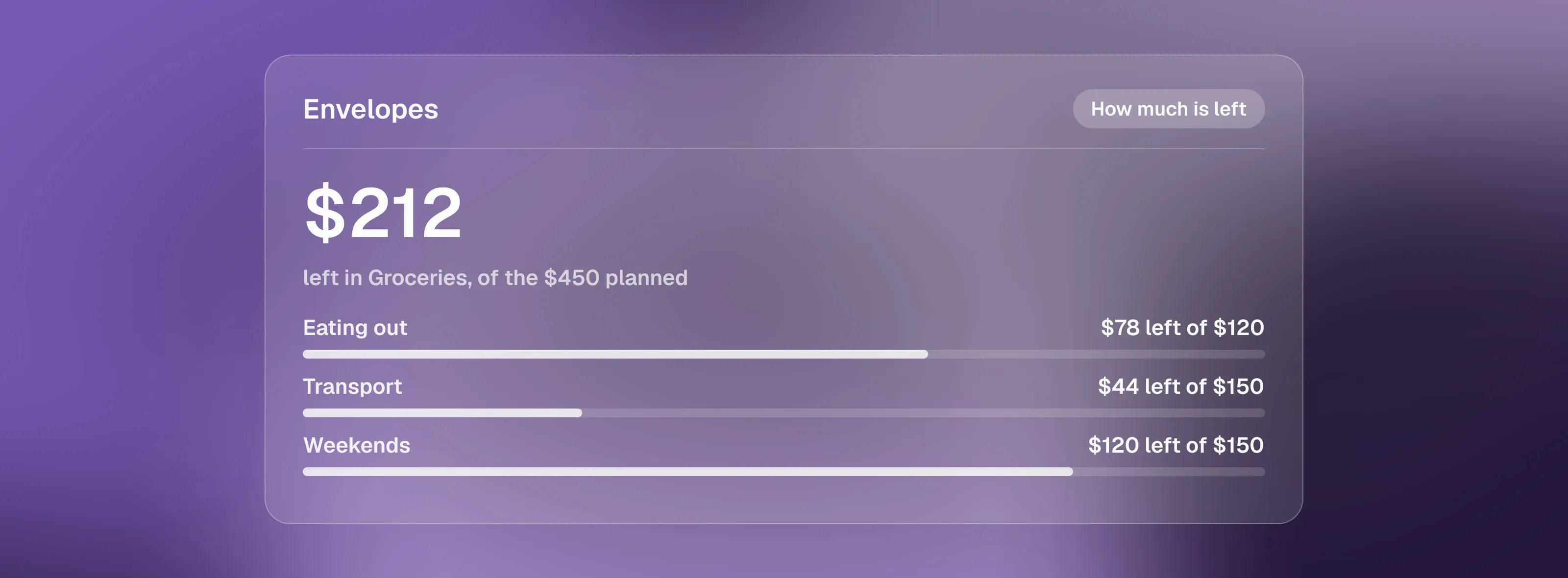
For decades, people have used the envelope method to bring clarity to their spending. It sounds old-fashioned, but the idea behind it is durable: when you divide your money into clear categories, decisions get easier. You can see what is available and stay connected to your month without stress.
Today the method lives in digital tools and simple routines rather than paper envelopes, but nothing about the underlying idea has changed.
What the envelope method really is
A simple way to give your money structure
You divide your income into separate envelopes, each representing a category. Groceries. Transport. Eating out. Savings. Subscriptions. Weekend plans. Whatever is actually in your life. Each envelope holds the amount you planned for the month.
Visual clarity makes decisions lighter
When you can see how much is in each category, you are not guessing whether your balance will stretch. You know — and that knowing is what makes small daily choices calm.
Why it still works
It matches how people naturally think
Most of us already think in categories when we spend. Can I afford groceries? Is there room for dinner out? The envelope method matches that intuition instead of fighting it.
It prevents invisible spending
Digital payments make it easy to lose track of where money goes. Envelopes bring back transparency, not in a punishing way but a structured one.
It reduces decision fatigue
Instead of constantly recalculating what you can spend, envelopes give you soft boundaries. They act like signposts: helpful rather than restrictive.
How it fits with zero-based budgeting
Zero-based budgeting decides what each amount of money is meant for at the start of the month. Envelopes are how you stay aligned with that decision through the rest of it.
| Question | Zero-based budgeting | The envelope method |
|---|---|---|
| When it happens | Before the month begins | Every day of the month |
| What it answers | What is this money for? | How much is left for this? |
| What it produces | A plan for the whole income | A running balance per category |
| What it does on drift | Rewrites the plan | Shows you the drift as it starts |
They are not competing methods. You plan with intention, then spend with awareness, and the two halves need each other.
What it looks like in real life
A calm monthly setup
You divide your income into categories that reflect your life this month. A rough split is fine as long as you can see where everything is.
Gentle adjustments along the way
If a category runs low, you move money from another. This is not breaking the system, it is using it the way it was designed.
Visibility brings confidence
Even if you do not check your budget daily, the envelopes give you steady orientation. You are not guessing, you are navigating.
How Lighthouse uses the envelope method
Categories in Lighthouse are yours to name and rearrange, each envelope shows what is actually left in it, and moving money between them takes seconds. When plans change, the adjustment is a few taps rather than a rebuild.
Start with two or three envelopes
The envelope method does not require a big commitment. Start with two or three envelopes — the categories that matter most this month — and add more as the rhythm becomes familiar.