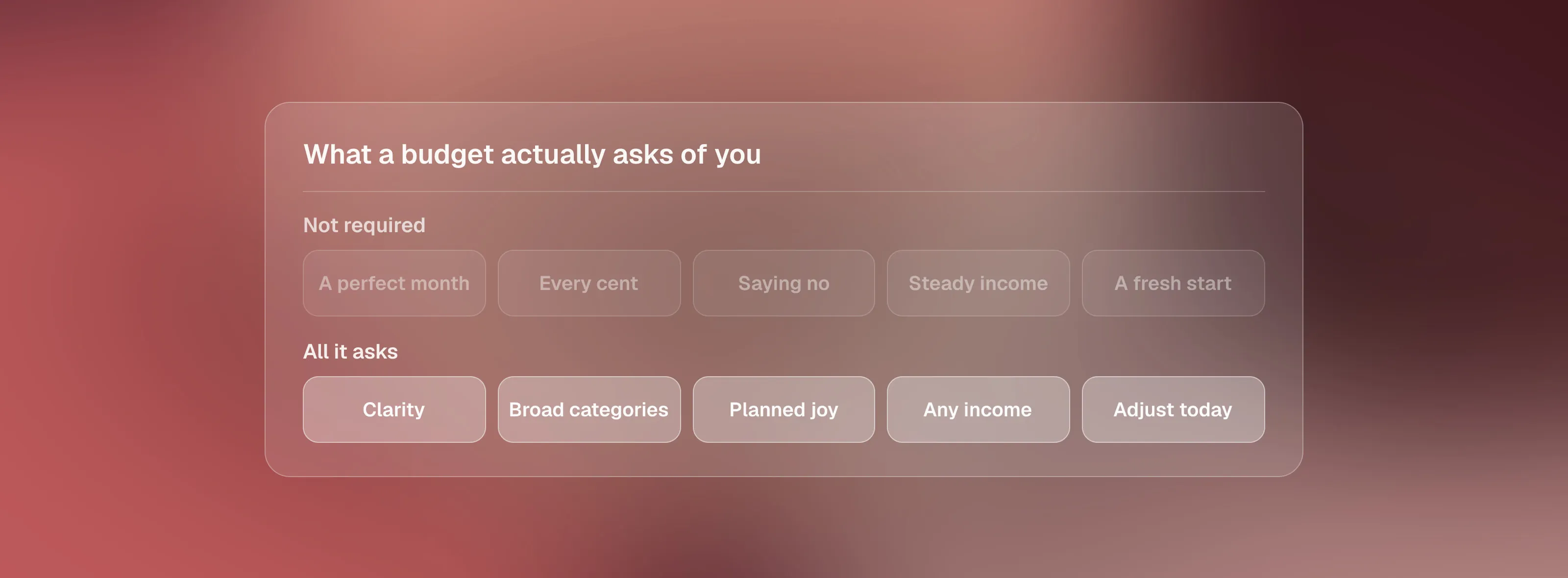
Budgeting feels confusing not because the arithmetic is hard, but because most of us carry quiet assumptions about how a real budget should look. Those beliefs come from old advice, strict rules and unrealistic expectations, and they make money heavier than it needs to be.
A budget is simpler than that: a tool for understanding your life a little better. Here are five beliefs that get in the way.
Myth 1 — A budget has to be perfect to work
Real life is not perfect, and a budget should not pretend otherwise
Life shifts. Plans change. Unexpected things happen. Nobody has a flawless month, and no budget needs to match a spreadsheet exactly to be useful. A good budget is not measured by precision but by clarity. If it makes one decision calmer, it is working.
Adjusting is not failure
When something changes, you move money, shift priorities, and keep going. That is not breaking the budget. That is budgeting.
Myth 2 — I need to track every cent
Awareness matters more than rigid accuracy
Tracking matters — it keeps your categories honest and your plan connected to reality. But you do not need perfect precision or every tiny detail recorded immediately. What matters is a picture clear enough that your categories reflect what is actually happening.
You choose the level of detail
Some people enjoy detail. Others prefer broad categories. Both count, and neither is the correct answer.
Myth 3 — Budgeting is restrictive
A budget shows what you can choose
Budgets get framed as “you cannot” tools. In reality a budget shows you what is, and helps you choose what matters. It is not there to restrict joy or spontaneity — it gives your money a direction that matches your life.
A planned joy feels better than an anxious one
When you have already set money aside for something nice — dinner out, a small treat, a weekend plan — the experience is lighter. Freedom grows as guilt shrinks.
A budget does not tell you no. It tells you what saying yes would cost, while you can still decide.
Myth 4 — My income is not consistent, so budgeting will not work
You can budget any income, stable or not
Budgeting with irregular income is entirely possible. You plan with what you realistically expect this month and adjust as things develop. There is a full guide to that approach.
Flexibility is built in
With inconsistent income, a budget becomes a living document you update as life unfolds. Less about precision, more about staying grounded.
Myth 5 — If I go off plan, I have to start over next month
There is no such thing as ruining a month
One unexpected expense, one overspend, one category you forgot — none of it means you failed. You do not need to wait for a new month, a Monday, or a fresh start. You can adjust today and keep going.
Continuous budgeting is calmer than restarting
When a budget is something flexible, the emotional weight of starting over disappears. You are just moving forward.
Let go of one belief first
If any of these felt familiar, that is normal — most people carry them quietly for years. You do not need to fix everything at once. Start by letting go of one belief that adds pressure: maybe perfection, maybe the guilt around adjusting, maybe the fear of doing it wrong.